
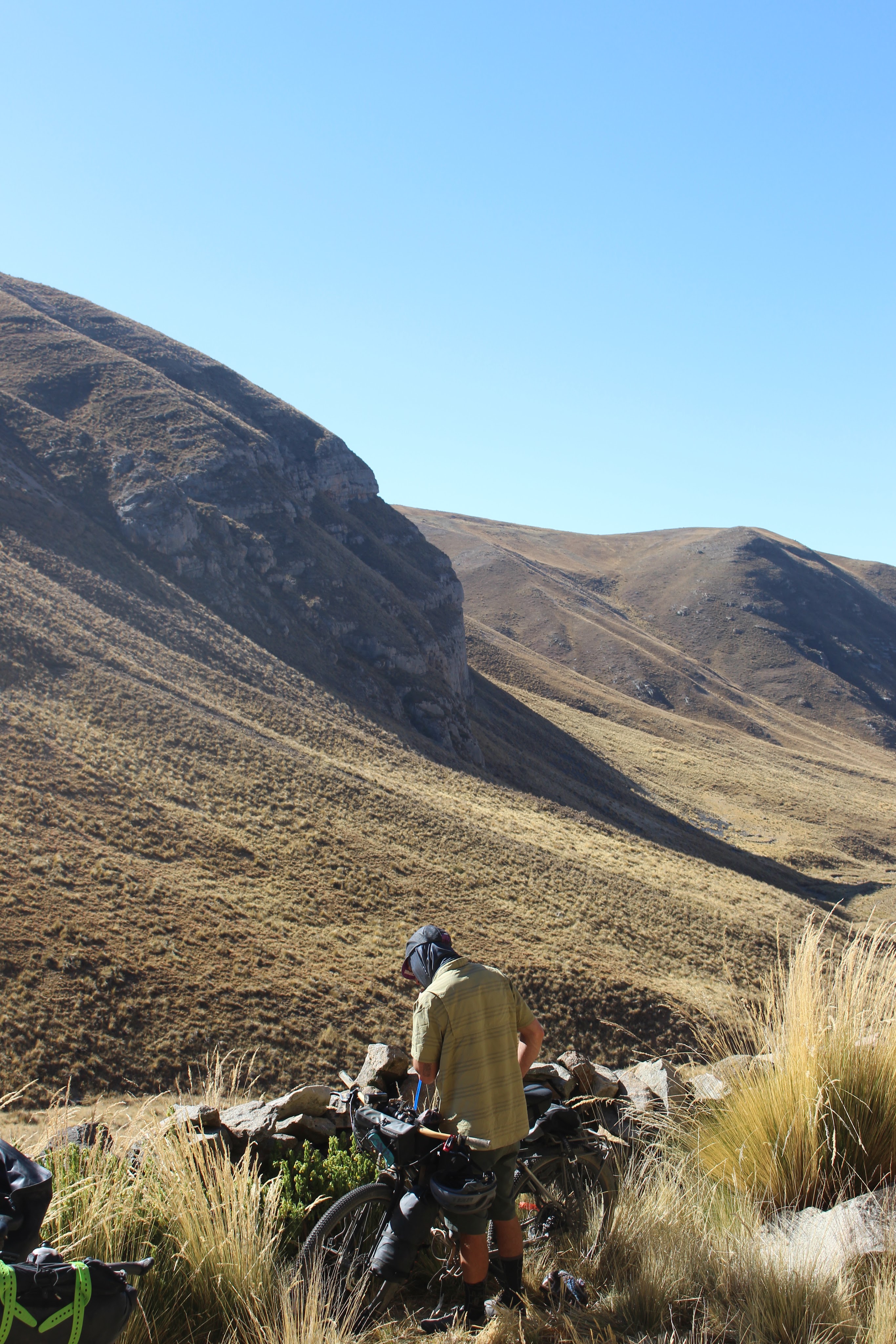
In the morning we rose in the usual fashion and began our day with a short climb out of the valley. My legs felt the previous days riding and the pass ahead of us, the highest of the trip, loomed in front. We crossed the wide alpine tundra and began a short, loose descent towards Mina don Mario. We found the mine empty, a few buildings and a tiny football pitch covered in weeds. Riding out, we passed the massive opening of a tunnel leading into the mine. I wondered if that’s where everyone was, hard at work inside the mountain and not playing football. We decided against going in and instead rode up the steep hill away from the mine and out into the wide open, towards the visible peaks ahead.
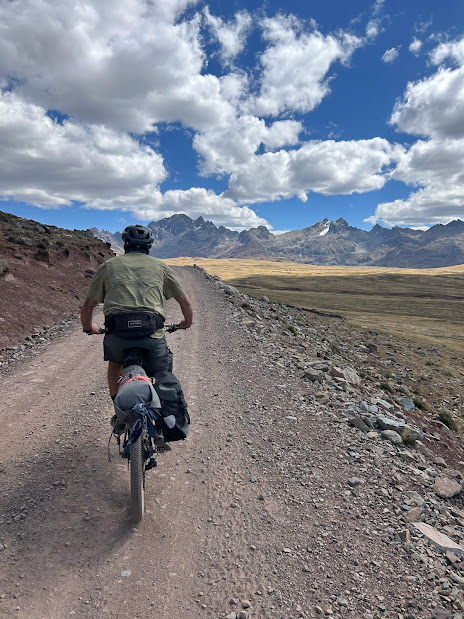
A group of about 10 animals ran in the distance, startled by our sudden appearance. I assumed they were llama and watched carefully for the dogs, riding slowly forwards. The dogs never came and as we drew closer to the herd I realized they were not llama or alpaca at all. They looked very similar but with a different coat and slightly smaller than a llama, more noticeably they were missing a shepherd and dogs. I shot a short video of them shuffling across the ground, running in circles, unsure of what to make of us. At the time I did not know what they were, now I am confident to say they were Vicuna. One of the two wild camelids native to Peru, the other being Guanaco, decedents from earlier camelids that emigrated to South America around 3 million years ago.
An hour passed as we gradually climbed towards the seemingly impenetrable wall of rock, that, according to the map, was a pass. We approached a large alpine laguna. Across the lake the rock wall grew larger, towering above us as the road began to climb, steeply, away from the water. The path clung to the rocks as it wound higher, switchback after switchback, up the face. From where we stood less than half the climb was visible but even that was enough to make my heart pump. The grades would reach 20% and the elevation 16,300 feet, our greatest challenge yet. We agreed to stop at every hairpin turn and after shoving some calories in my face, we got cranking.
The going was slow but the views outstanding. Reaching a small saddle we found another lake, completely surrounded by steep rocks walls and clear enough to see far into the depths. The road cut through the scree field and wound over another small crest. On a narrow section, with loose boulders on one side and the steep drop to the lake on the other, we ran strait into a full herd of sheep. The livestock scrambled up the hill while men followed, whistling the sheep off the ankle breaking rocks. We were edging closer and closer to the drop off, while the sheep stumbled to get away. Two men on foot pushed the animals down and back on the road. Behind, a teenager followed on a motorbike, in a backpack he carried a tiny lamb, too small to climb the high pass alone. The group wished us luck and pushed on.
Around the corner I could see the top, only a few hundred feet higher but I couldn’t pedal anymore. I got off to push, making it only a few yards before stopping to catch a full breath. I continued like this as the road got steeper and looser, eating small bites of food and sipping on water when I stopped. We made the top, greeted once again with a view of the seemingly endless Andes and another road of my dreams. We left the bikes and scrambled higher on the craggy mounds, trying to get higher than each other and higher than ever before in our lives. We reached 16,400 feet.
Before us was a 6,000 foot descent, to the town of Laraos, where we hoped to find a shower and a bed for the night. On top of our highest pass and with our largest downhill ahead, we had made a huge milestone and it felt good. I enjoyed more snacks and water but soon it was time to go down.
The hairpins curved down the steepest bits, eventually straightening out lower down. The road was good and fast with only a few loose corners but I was still grateful for my front suspension. The trail continued to dive down, farther from the high peaks and deeper into the green valley. Ahead of us the landscape fell away and in the distance we could see Laraos, clinging to the hillside. We flew down the hill, arriving in town just before sundown. Tired and accomplished.


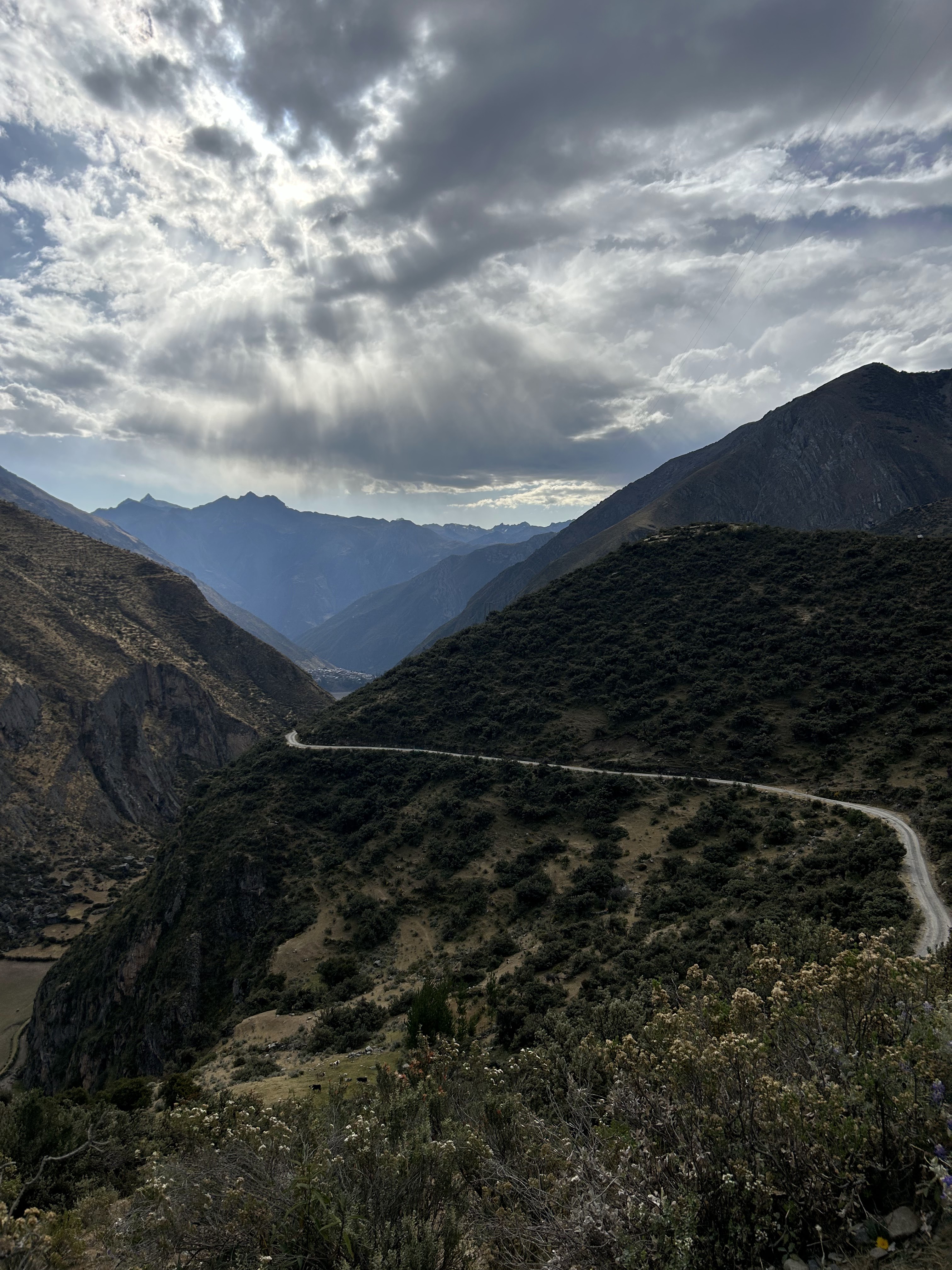
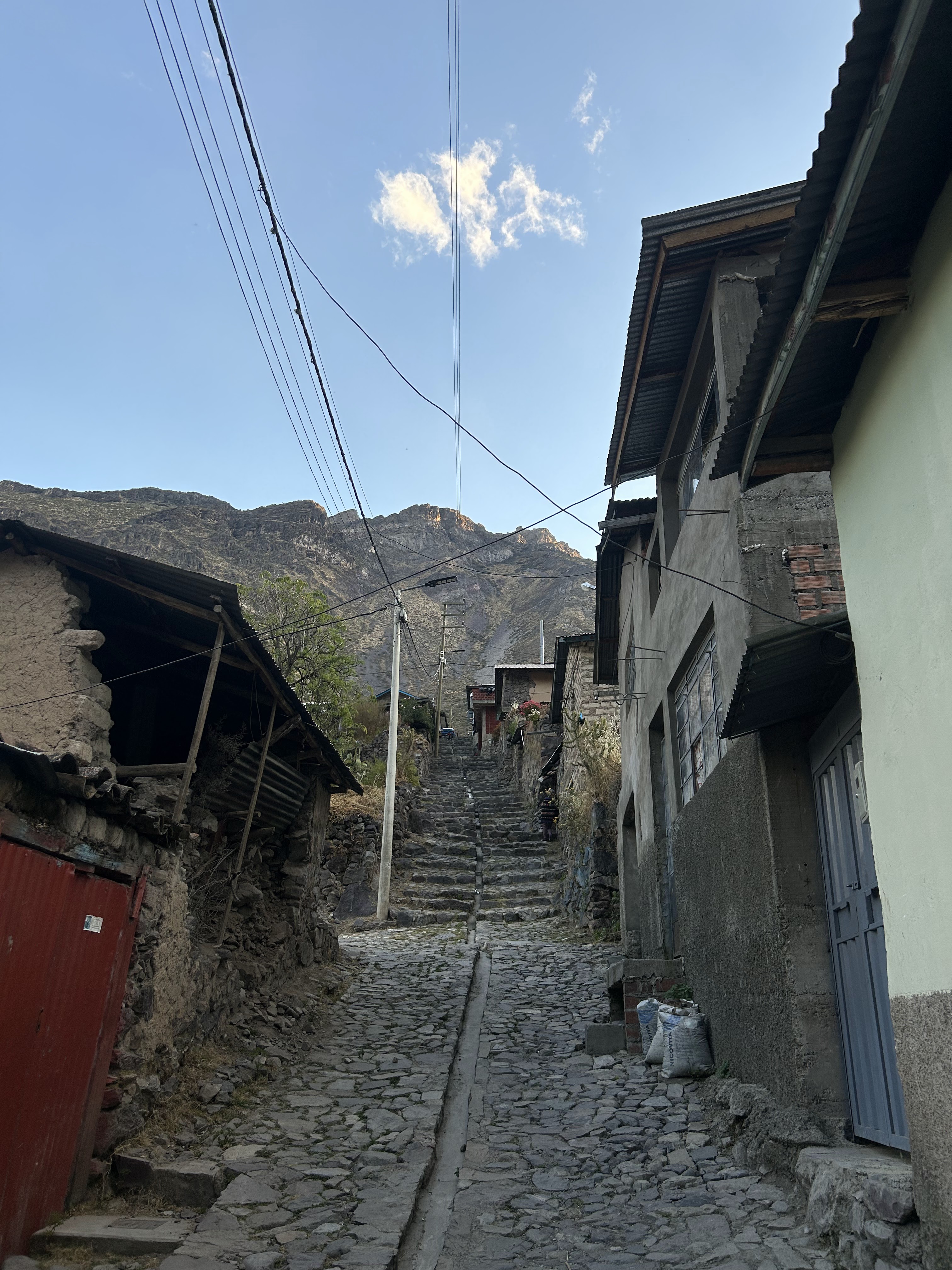
Laraos is built into the side of a steep hill near the bottom of the valley. On the high side sits a lake or dry lake bed, depending on the season, in July it was fully dry with a football pitch drawn in the sand. We picked the hostel near the road at the bottom to avoid hauling our bikes up the steep, cobbled streets. After paying the equivalent of 10USD, we found our room comfortable and out of the elements but with no shower. Disappointed, as without a wash we might as well sleep in the tents, Alexander went to find the owner and inquire about a shower. They returned and we followed as the man led us down the hall to a separate room where we could wash. There was a pipe dangling from the ceiling and no hot water but it felt nice to wash off four days of dirt. Once refreshed, we wandered up the hill in search of dinner. Most places looked shut as we passed, just as we began to worry we wouldn’t get dinner, a woman approached us, speaking Spanish. I asked her where we could find food, noticing my bad accent she responded in English. She said she would take us to her friends restaurant, which should be open late. We walked together through the evening light, through a town unlike anything I had seen before. The woman used Spanish and English to communicate, explaining she knew 3 languages, including Italian and that she had lived in Laraos for over 30 years. Eventually we returned to one of the restaurants we had passed earlier. Our friend wrapped on the metal gate, waited, and let herself in. Instructing us to wait, she walked inside calling for “Ruth”. Two minutes later we were sitting down, eating corn nuts and drinking tea. We wished our friend good luck and goodbye as she disappeared through the gate. I ate soup with rice, and drank mint tea as the sun sank behind the hill. After dinner, outside in the ally, the owners of the restaurant told us to return for breakfast in the morning, they would have trout ready for us.
Walking back to our room, I felt thankful for the random acts of kindness we had received, and wondered how we got so lucky.

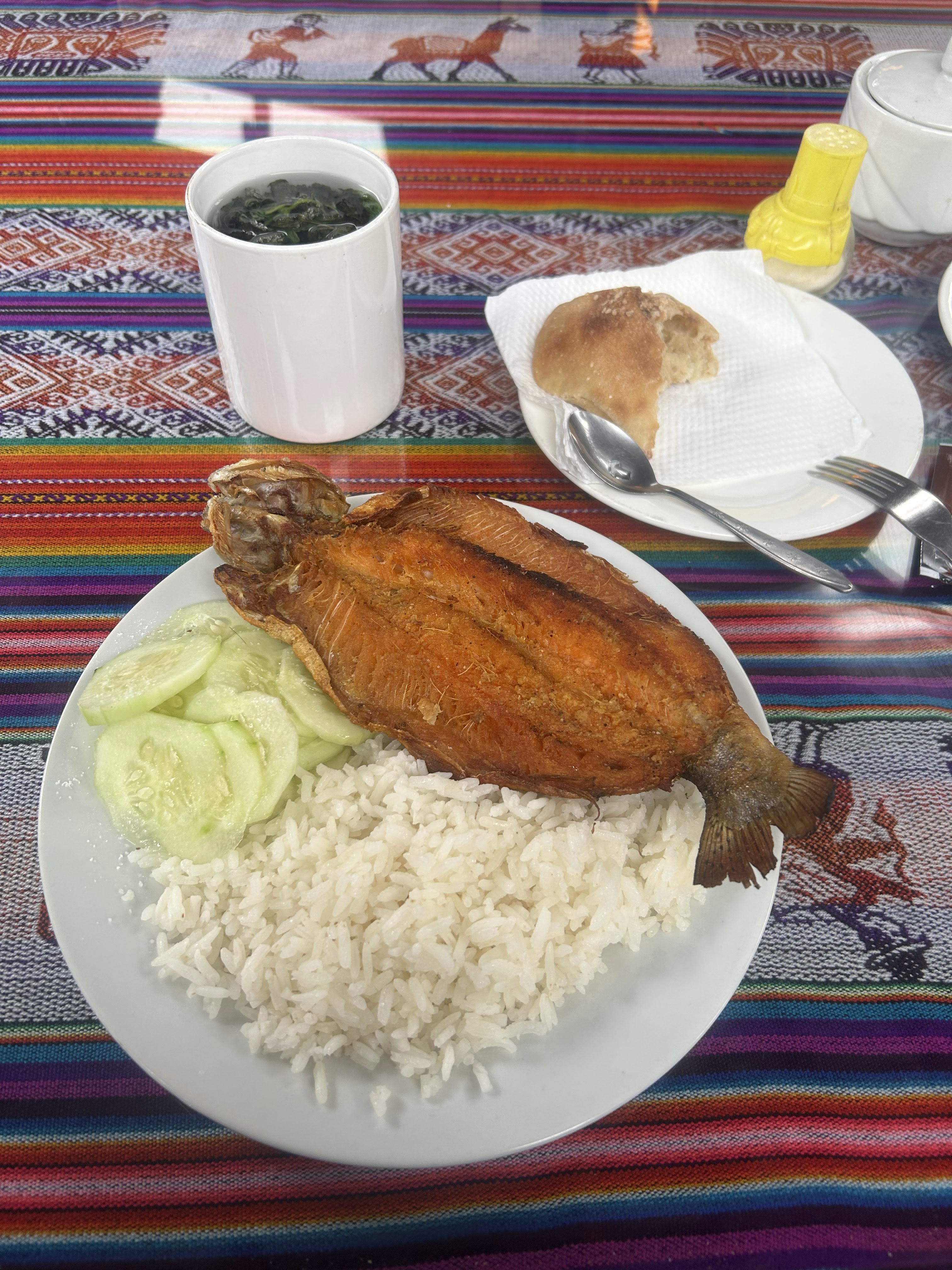
There was no heat in the room but wrapped in four, thick, llama wool blankets, I woke in the morning cozy as ever. The nights were still cold bellow 10,000 feet, even inside. We returned to Ruth’s place, gate open this time we walked in and were greeted by the same man from the night before. We sat and ate, explaining to our friendly hosts where we were from and where we were going. The food was good, but the people were the highlight. Opening late for us the night before and preparing trout for us early in the morning, they went above and beyond. That’s probably how they treat everyone but I made a point of leaving a 100% tip when the bill came. A seven dollar meal became fourteen dollars, still far cheaper than the US, but worth far more to myself and hopefully them.
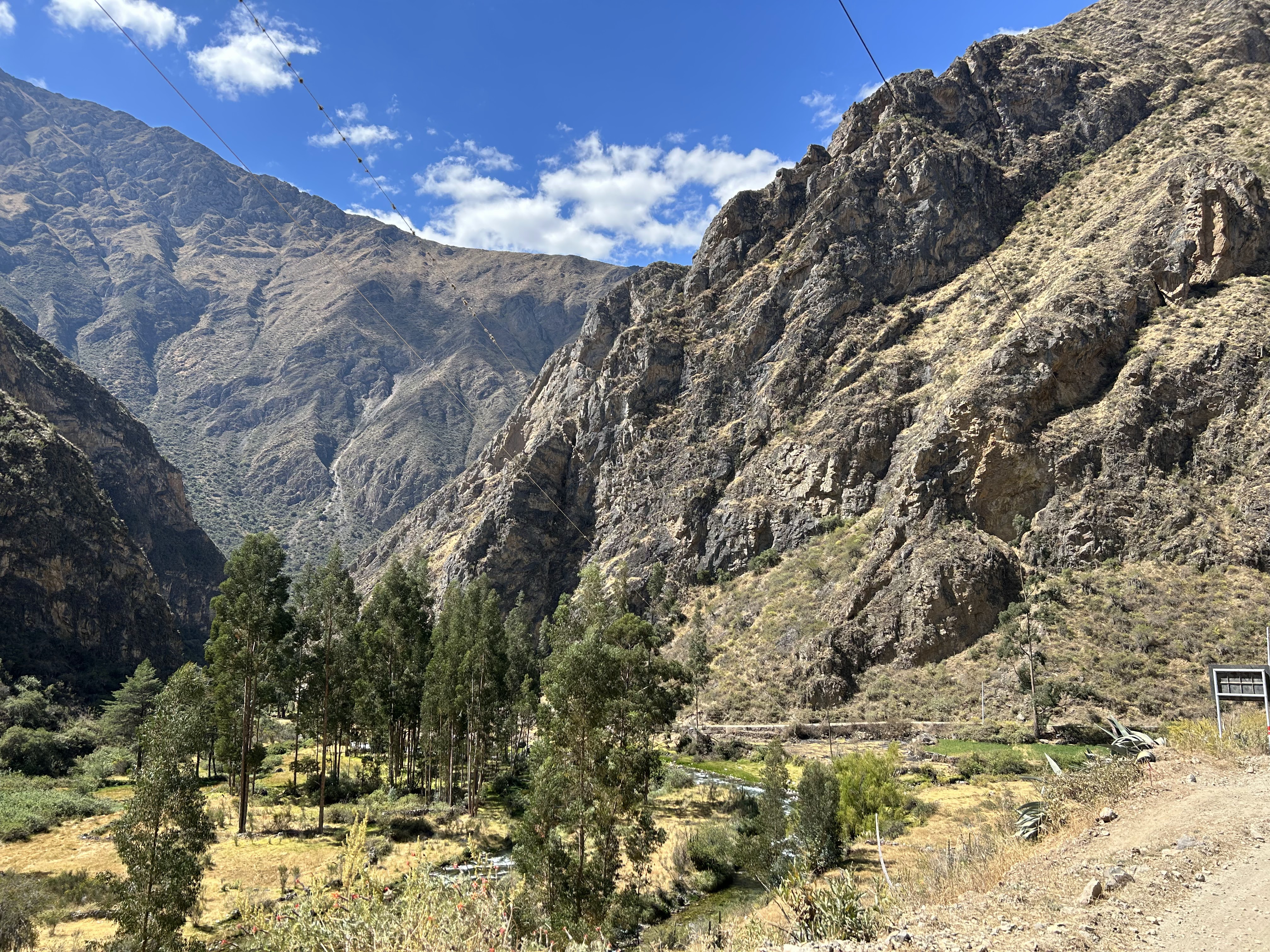
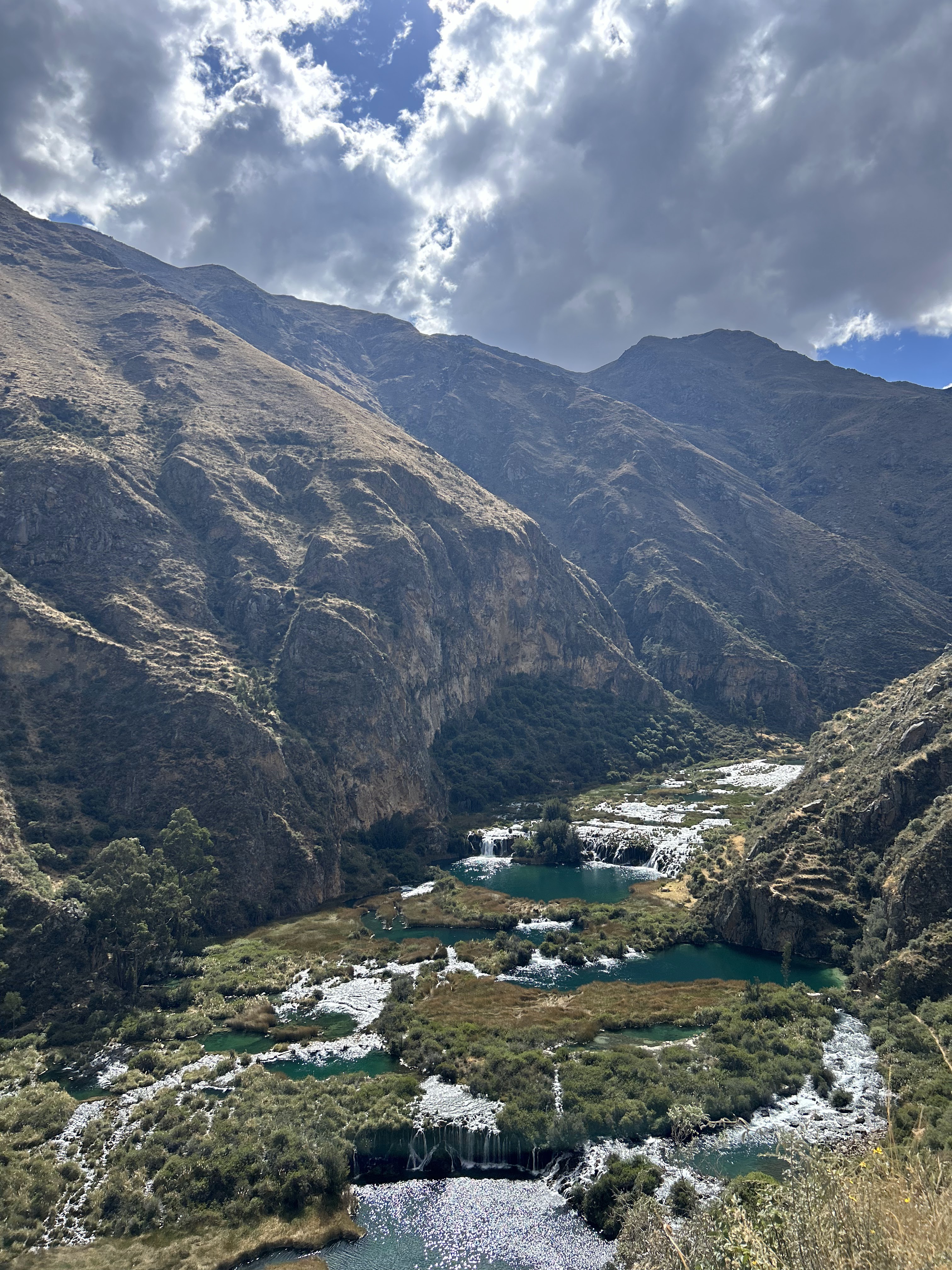
Back on the bikes we continued where we had left off, flying down the hill even further, eventually reaching the brilliant blue waters of the Rio Canete. At 9,900 feet it was the lowest point on our route since Huancavelica. Following the river up stream we climbed towards the largest town on our route, Huancaya. (Not to be confused with the much larger city, Huancayo). In town we refilled water and looked for gifts for our friends back home. We discussed staying in town for the night, paying for another bed and shower, but the day was early and with more hills to climb, we set off. Leaving Huancaya we were stopped at a gate and told to pay the tourist fee. Only 5 dollars each, expensive for a country where one dollar buys your lunch but for a good cause. I payed the fee and rode off. The road followed the river, quickly climbing high above its bright blue water. Hundreds of waterfalls, dropping into one another, tumbling down in steps, created endless pools. It was one of the most beautiful scenes imaginable, and a refreshing contrast from the wind swept tundra of days before.
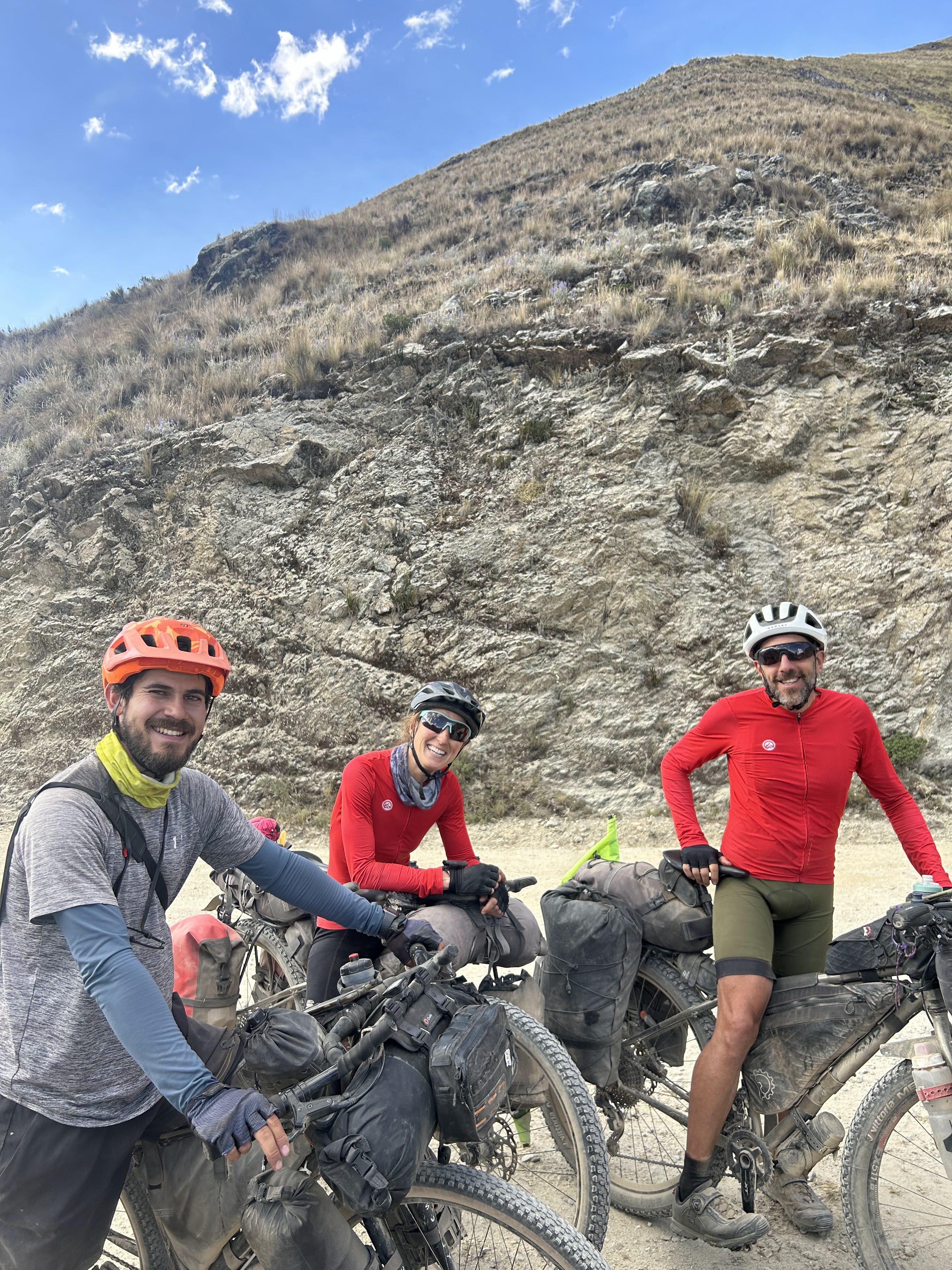
As we crested the top of our climb I spotted a few cyclists coming up the other side. Our paths crossed and we stopped to chat. The group were the first bike packers we had seen and made for a pleasant surprise. We swapped stories and advice for the passes that lay ahead of us. Most valuably, they told us about their experience riding the very busy Caraterra Central, explaining the intensity and danger of that road. Imploring us to avoid biking it at all costs, they listed a few places we might look for a taxi to take us down once we got there. I thanked them and wished them luck on their journey all the way to Tierra del Fuego, the most southern tip of South America. Six months on the road and at least six more to go, I wondered if I would ever do a ride that long.
That night we camped just off the road next to the river. I lay in my bag, nervously wondering how we would make it back to Lima, kicking myself for not properly planning such a crucial part of the trip. By then I knew we wouldn’t be pedaling the 100 miles of busy road back to the city, I just hoped we could find a ride.
Later I tossed around in my sleeping bag, anxious and out of breath. The feeling of being unable to fill your lungs is terrifying, your heart begins to race and your mind runs. I sat up in my tent, forcing myself to relax and reminding myself that I was getting enough oxygen. It took a few minutes but I caught my breath, able to pull a full yawn, I sank back into my bag and fell asleep.
 Rolling Wheels
Leave a comment